Hospitality and the Architecture of Trust
This article was first published by OfficeETCulture, issue n.79. It is reproduced here with the publisher’s permission.
In a world where digital communication has become the norm, the rare moments of face-to-face interaction have taken on particular significance.
Arriving at a company’s headquarters, being welcomed into a reception area, walking to a meeting room, or simply experiencing the atmosphere of a waiting lounge have all become defining elements in how an organization is perceived.
This is the central insight of Allure’s white paper Decisive Environments, dedicated to spaces designed to welcome clients, partners and decision makers. For a company specializing in the design and fit out of premium work environments, the challenge is no longer simply to create offices, but to orchestrate an end-to-end experience that strengthens trust and creates the ideal conditions for meaningful strategic exchanges.
Experience before square footage
In industries where relationships are a key asset, such as private banking, consulting, legal services, luxury or finance, a visit is never just a formality.
For Allure, every detail contributes to a silent evaluation of the organization. The experience begins with the invitation itself. The confirmation email becomes, in a sense, the new business card: clear information, seamless access, anticipation of specific needs, and careful consideration of travel or accessibility requirements. Every detail conveys a sense of professionalism, control and attentiveness.
This same level of anticipation continues throughout the visit. The welcome, the management of waiting time, the quality of meeting spaces, the smooth delivery of services and even the departure experience are all designed as parts of one continuous journey. The objective is not to multiply visible gestures of hospitality, but to eliminate any friction that could distract from what truly matters: the relationship and the decisions being made.
The office is now drawing on the codes of hospitality
This evolution reflects one of the most significant trends observed in recent years: the growing influence of hospitality on the corporate world.
Today’s visitors are accustomed to the exceptional standards of five-star hotels, fine dining restaurants and luxury establishments. They have come to expect high standards of service, comfort and attentiveness, and these expectations are now shifting toward the workplace.
Modern hospitality is defined less by the number of services offered than by the quality of their orchestration. A personalized welcome, thoughtfully curated catering, discreet handling of requests, operational excellence and carefully choreographed key moments all contribute to transforming a workplace into a true relationship-building environment.
For Allure, delivering this experience requires close collaboration between designers, hospitality teams, workplace services, security, IT and executive management. Experience becomes a cross functional responsibility that extends far beyond workplace design alone.
Trust is also built through space
One of the white paper’s key findings concerns the nature of trust itself.
In many professional environments, confidentiality is essential. It depends not only on contractual commitments but also on the physical characteristics of the space. Acoustics, circulation, visibility, traffic flow and the layout of meeting rooms all contribute directly to creating a sense of security. An inadequately soundproofed partition, a poorly positioned corridor or an overly exposed meeting room can undermine the discretion visitors expect. Conversely, a carefully designed environment naturally reinforces trust between all parties.
This approach has led some organizations to create dedicated visitor journeys for strategic guests, featuring separate entrances, independent reception areas and multifunctional meeting spaces designed to preserve confidentiality throughout the entire visit.
Where the senses take the lead
Yet the quality of an experience is never defined by spatial organization alone.
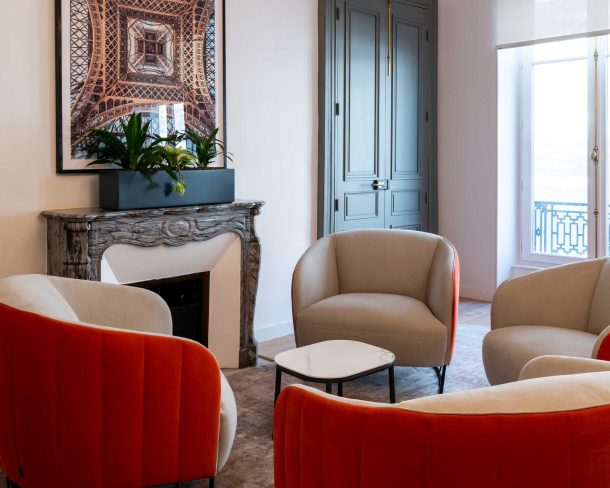
Materials, lighting, acoustics, artwork, greenery and even signature scents work together to create a distinctive sensory identity, one that often leaves a stronger impression than words ever could. Every material tells a story. Natural stone, handcrafted woodwork and hand finished details convey durability, excellence and authenticity. Visitors may not consciously notice these choices, but they instinctively sense what they communicate.
Art also plays a unique role. Strategically positioned along the visitor journey, artworks create a narrative that transforms corridors and transitional spaces into memorable moments.
Even sound has become a design tool. Beyond acoustic performance, some organizations now use carefully designed soundscapes or background music to enhance comfort, preserve confidentiality and support the different rhythms of the working day.
A new definition of performance
This growing attention to experience reflects a deeper shift in how performance itself is understood. As Myriam Durand, former CEO of Moody’s Ratings France, points out, the value of a workplace extends well beyond traditional performance indicators. While certain outcomes can be measured, such as attendance, absenteeism or ergonomic comfort, the most significant benefits are often human: a stronger sense of pride, richer interactions, easier collaboration and spaces that genuinely support the way people work.
The true return on investment of a workplace lies in its ability to foster smoother conversations, stronger relationships and calmer, more confident decision making.
Designing decisive environments
For Allure, one conclusion stands out: the highest performing spaces are those that become almost invisible. They are not designed to impress through ostentation, but to allow relationships to develop naturally. Every element, from the initial invitation to the final farewell, contributes to a seamless, coherent experience in which design, hospitality and operations work together as one.
As companies work to strengthen their attractiveness, enhance their brand image and deepen their strategic relationships, the workplace experience has become a powerful differentiator. No longer simply a backdrop, it has become a strategic tool that supports trust, engagement and long term performance.
↗ Discover more in Decisive Environments: Creating Memorable Experiences for Strategic Partnerships