Neurodiversity: a Standard for Excellence in Workplace Experience
To mark the inauguration of the new CoreNet Global France Chapter board, presided by Xavier Perrin, Global Head of Real Estate at L’Oréal, Allure hosted an evening of connections and discussion, bringing together workplace leaders and experts from around the corporate real estate industry.
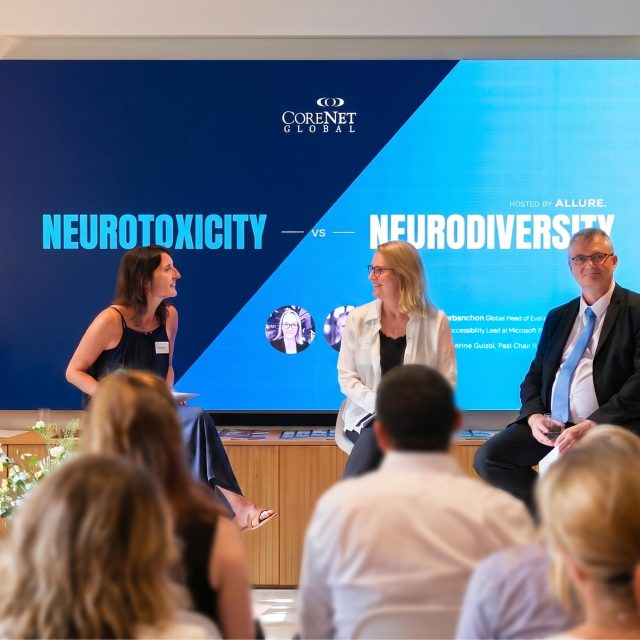
The evening’s panel discussion, « Neurotoxicity vs. Neurodiversity: Rethinking Design to Transform the Workplace Experience, » featured Philippe Trotin, Accessibility Lead at Microsoft France, and Laurence Lebarbanchon, Global Workplace Director at L’Oréal , and was moderated by Catherine Guizol, former President of the CoreNet France Chapter.
Together, they explored a question that is becoming increasingly relevant for organizations: how can workplace design respond to what research is showing us about diverse sensory processing among people, and better support the ever-increasing number of people who are neurodiverse (ADHD, OCD, autistic, …), and find ways to support the expression of their unique talents as a competitive advantage for organizations.
What If the Most Inclusive Spaces Were Also the Highest Performing?
As organizations become more global, multigenerational and culturally diverse, they face a simple reality: there is no single way to work, collaborate or experience the workplace.
One idea emerged consistently throughout the conversation: neurodivergent individuals should not be viewed as a niche group with special requirements. Instead, they often reveal needs that are also relevant to the wider workforce, but who are less sensitive to them. By understanding the friction points neurodivergent people experience, organizations can create environments that are more intuitive, adapted, supportive and effective for everyone.
For workplace professionals, this means moving beyond workplace experiences designed for an average user. It challenges us to rethink design through the lens of the diverse ways people experience, perceive, and interact with their environment.
I. Designing for Human Diversity Improves the Experience for Everyone
Drawing on her experience in Research & Development at L’Oréal, Laurence Le Barbanchon reveals an unexpected parallel between product development and workplace design.
In the case of product development, she explained how teams often rely on « extreme users » when developing products. For example, a shampoo designed to perform on very curly hair in Brazil’s humid climate or a foundation tested in extreme heat and humidity will ultimately perform better for a much broader population.
According to Lebarbanchon, the same principle applies to workplace design.
Neurodivergent individuals often notice environmental factors that others experience too, but less consciously or less intensely. The hum of a ventilation system, harsh lighting, visual clutter, or excessive reverberation can quickly become barriers to concentration, social interaction and wellbeing.
Designing with these sensitivities in mind doesn’t just create more inclusive workplaces; it creates better ones that reduce unnecessary cognitive and sensory strain, what we might call “neurotoxicity,” for everyone.
This is what Philippe Trotin described as universal design: the idea that innovations rooted in improving accessibility for people with disabilities often end up benefiting a much wider population. Subtitles, remote controls, even ergonomic kitchen tools, all began as solutions for specific needs before becoming part of everyday life for everyone.
The same is true of workplace design. We can consider neurodivergent people like canaries in a coal mine who show us what needs to be addressed, and who can help us find innovative ways to increase comfort, efficiency and ultimately quality of life.
II. Compliance Does Not Guarantee a Positive Workplace Experience.
For decades, workplace performance has largely been measured through technical metrics: acoustic levels, lighting standards, thermal comfort, occupancy ratios, and indoor air quality.
But as Lebarbanchon highlighted during the discussion, compliance does not necessarily translate into a positive experience.
A workplace can meet every technical requirement while still creating what she described as a form of « cognitive dissonance » for its occupants – an environment that creates subtle cognitive friction when its sensory messages are inconsistent.
She shared the example of beautifully designed spaces at L’Oréal that were intended to feel calm and restorative yet were surrounded by highly stimulating campaign imagery. Feedback from employees revealed that the environment felt visually overwhelming and made it harder to focus, prompting the team to reassess how the space balanced brand expression with cognitive comfort.
Other examples of this type of “cognitive dissonance” in the workplace can include:
- Beautiful, bright dining areas where conversations and background noise become difficult to filter due to a lack of appropriate reverberation management.
- Providing impromptu meeting spaces in open-plan environments near workstations with the intention to increase spontaneous collaboration but that actually interrupted focused work.
- Bold floor patterns chosen for their visual interest, but that actually create visual overstimulation and even depth-perception issues.
- Integrating many screens and digital content with the desire to create a stimulating and dynamic environment, but that actually creates eye strain, visual clutter, and competes for employees’ attention.
- Phone booths that offer privacy but may create feelings of confinement or hypervisibility for some users.
The question is therefore no longer simply, « Does the space meet the standard? » but rather, « How does the space feel to the people using it? »
This may well be one of the workplace profession’s next major challenges: integrating perception, emotion, and lived experience alongside traditional technical criteria.
III. The Workplace Is More Than a Functional Environment. It Is a Sensory Experience.
A recurring theme throughout the discussion was the recognition that people do not work solely with their intellect. They work through their entire sensory system.
Examples of workplace “neurotoxicity”, such as the sound of a mechanical keyboard, the background hum of ventilation, background noise, strong scents, bold and bright colors, flickering or glaring lighting, clumsy transitions between spaces or the visual density of an environment all influence our ability to focus, collaborate, recover and perform.
To illustrate this, Trotin shared insights from projects at Microsoft. While designing a learning environment for individuals on the autism spectrum, seemingly minor details proved critical. The sound of an object falling on a hard floor could disrupt concentration for an extended period. Ventilation systems became a constant source of distraction. Standard classroom lighting created unnecessary sensory stimulation.
The solutions themselves were relatively simple: carpeting to absorb impact noise, differentiated lighting strategies, quieter mechanical systems and spaces where individuals could temporarily withdraw and regulate their sensory load.
These examples remind us that the role of workplace design is not simply to eliminate discomfort. It is also to create environments that support different cognitive states: concentration, creativity, collaboration, recovery and calmness.
In other words, the ambition should not be limited to preventing negative experiences. It should be to design environments that enable all people to perform at their best.
Neurodiversity in the Workplace: From Inclusion to Performance
For Allure, this conversation reinforces a fundamental belief: the best workplaces are not those that simply meet a technical brief. They are the ones that understand human needs in all their diversity.
Designing for neurodiversity is absolutely compatible with the standardization required for global roll-outs. Designing for the most sensitive users is not about creating special environments for each special need. More often, it is about smart design choices that are ultimately the most effective way to create spaces that are intuitive, inclusive and high-performing for everyone.
For today’s leading global organizations, different cultures, generations, personalities and working styles coexist within the same environment. Winning environments are those that offer choice, flexibility, and different levels of stimulation allowing people to find the conditions in which they work best.
Integrating neurodivergent individuals into the project process early on helps us identify the breadth of experience we need to design for.
At its core, the discussion highlighted a universal truth: people do not perceive, think or work in the same way. Designing for that diversity is no longer just a question of inclusion, it is essential to creating workplaces where people can truly thrive.