When Architecture Reveals a Law Firm’s Brand Identity
This article was first published on LJA.fr. It is reproduced here with the publisher’s permission.
By Laura Dray
At a time when international law firms across EMEA are rethinking their attractiveness, office interior design is becoming a genuine strategic lever. Following the publication of our white paper Unlocking Law Firms: 10 Workplace Trends Across EMEA, LJA sat down with Keti Bicolli, Head of Design at Allure, who decodes the challenges of brand image and explains how architecture subtly conveys a firm’s DNA, both to employees and clients.
How would you define the concept of brand image today?
KETI BICOLLI: Translating a brand into space goes far beyond a simple logo or brand guidelines. Of course, visual branding matters, but a brand is above all a set of values, ways of working, levels of expectations, and overall experience.
At Allure, we speak of “aura.” We analyze it through three lenses: “brand,” “people,” and “space.”
- Brand refers to the brand identity itself.
- People relates to culture and the human dimension.
- Space, which is our playground: a building’s history, technical constraints, and architectural potential.
The goal is to subtly express what the brand wants to convey: confidentiality, international reach, precision and premium experience. This coherence is essential both to create a sense of belonging and pride among employees, and to clients, project a clear, consistent image aligned with the firm’s values.
How do you reconcile a law firm’s brand image with the urban landscape, particularly in a city like Paris?
Allure operates across the EMEA region, which allows us to observe a certain standardization of expectations, especially in business districts.
In Paris, location remains a strong marker of prestige, particularly in areas such as the 8th arrondissement or the Golden Triangle. These districts carry history, image, and standing that resonate with the brand identity of many law firms.
For example, Haussmann-style settings are very demanding: moldings, gilding, listed buildings. Depending on the project, we may choose to neutralize these elements, counterbalance them with more contemporary design choices, or highlight them differently. The idea is always to express a prestigious, high-quality image without becoming ostentatious, depending on our clients’ expectations and brand image.
We also conduct a very detailed analysis of the neighborhood: restaurants, services, sports facilities. The building itself can compensate for what the district lacks, for example by creating terraces or quieter, greener spaces.
Have you observed situations where office design directly improved the employee experience or transformed their relationship to work?
Yes, very clearly. The integration of technology, particularly in meeting rooms, can transform daily life by avoiding wasted time, facilitating exchanges, and streamlining collaboration.
Less visible elements also have a considerable impact: silent yet efficient ventilation, easily adjustable temperature, controlled acoustics. The transition to digital solutions also frees up space and allows for more streamlined environments.
We also place great importance on shared and informal spaces: areas for social interaction, multipurpose spaces, cafeterias that can evolve into other uses. Lighting and intelligent partitioning also play a key role in employee well-being.
To what extent does office design influence the perception of a law firm from the very first client meeting?
The first impression is the address and location, especially important for an international clientele. But the experience truly begins upon entering the premises.
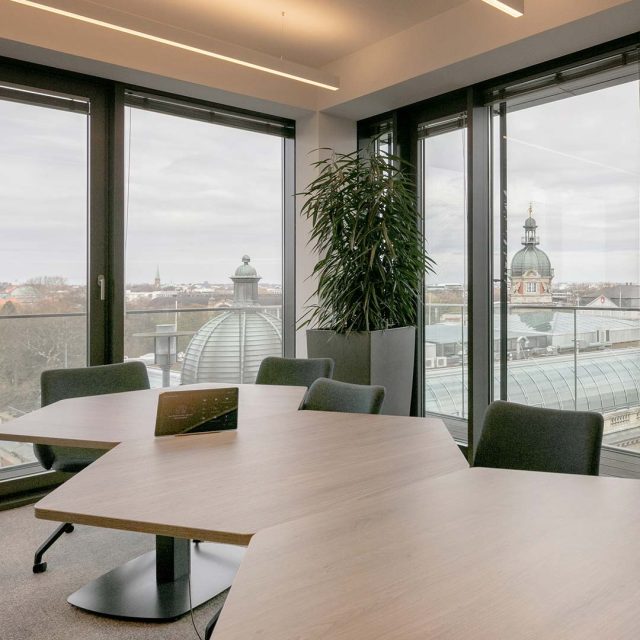
The client journey, the level of calm, the quality of reception, the visibility (or discretion) of services: everything matters. The choice of meeting rooms is also highly strategic. Some are equipped with state-of-the-art technology, others are deliberately designed as lounge-style rooms without screens, to foster a different kind of relationship.
Materials, textures, comfort, and ergonomics all contribute to this perception of quality. A discerning client quickly perceives whether they are facing imitation or authentic materials. Quality often lies in subtlety and detail.
What are the most frequent challenges law firms face when designing or renovating offices?
A common difficulty is the lack of long-term anticipation. Some projects address immediate needs without sufficiently integrating future flexibility, leading to short-term solutions that limit growth and evolution.
There is also still confusion between partitioning and confidentiality. Confidentiality can be ensured without enclosing everything, through strategic layout decisions, acoustic treatment, and spatial hierarchy. These are areas in which we regularly support our clients.
Could you share an emblematic project led by Allure for a leading firm or company?
Among our projects, I can mention an Italian client we supported who moved to a highly vertical seven-story building with a protected archaeological basement. These remains needed to be showcased.
We imagined a prestigious, almost theatrical space, with an antechamber leading to an event area. On the sixth floor, we designed highly confidential meeting rooms, facilitating circulation and secure access. Behind these rooms, additional confidential spaces were integrated, and we created two separate entrances to allow discreet access and avoid any conflicts of interest.
On the top floor, we designed a piano bar surrounded by a panoramic rooftop terrace, with continuous barista service, offering a unique experience. For this project, we drew significant inspiration from the hospitality industry: in the services, layouts, desired atmosphere, and hidden logistics supporting the level of service.
Discover the white paper Unlocking Law Firms: 10 Workplace Trends Across EMEA intended for international law firms wishing to expand their real estate presence in Europe.


